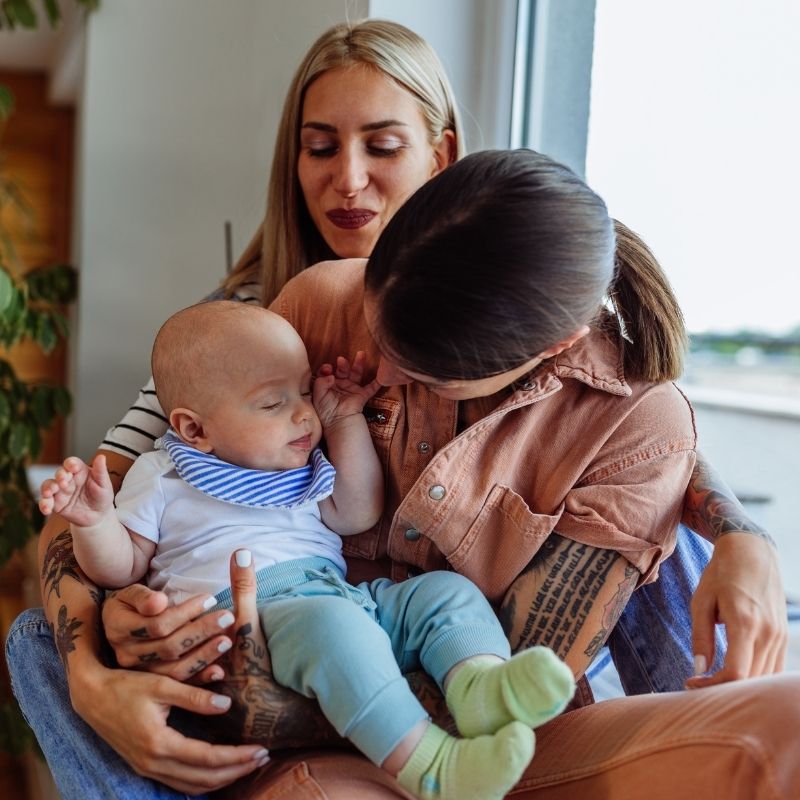
In family law, Parental Responsibility (PR) encompasses all the “rights, duties, powers, responsibilities and authority which by law a parent of a child has in relation to the child and his property” (s.3(1) Children Act 1989). This is an important right and duty that is required to make any decision relating to the care of a child.
When a child is born to a heterosexual couple, PR is automatically granted to the mother by virtue of being the birth mother. If the father is married to the birth mother, he will also acquire PR. If the parents are unmarried, the father may be registered on the birth certificate, which shall also grant him PR.
However, there is a different approach for LGBTQ+ couples, specifically same-sex couples. The granting of PR to parents will depend on the method of conception of the child and who the law therefore recognises as the legal parent of the child. For the purposes of this blog, we look at cisgender (gender identity the same as the gender assigned at birth) male and female same-sex couples.
Female same-sex couples
If a female same-sex couple choose to undergo treatment through a licensed clinic to conceive a child, the woman who carries the pregnancy and subsequently gives birth will be the birth mother. The birth mother, as above, shall be granted automatic PR as a result.
The second female parent (who does not carry the pregnancy) can be the other legal parent of the child if she is married or in a civil relationship with the birth mother. Section 42 of the Human Fertilisation and Embryology Act 2008 (HFEA) confirms that the female partner or wife of the mother who has undergone reproductive treatment to conceive a child through a licensed clinic will therefore be the second parent of the child in law. By virtue of the same, the second female parent will also acquire PR for the child.
If the two women are unmarried but undergo conception through reproductive treatments through a licensed clinic, then by virtue of Section 43 HFEA 2008, the second woman can also be recognised as the child’s second legal parent. As such, when registering the birth of the child, PR is granted (in a similar way as to unmarried fathers as explained above).
If for whatever reason a female same-sex couple do not undergo treatment through a licensed clinic, and are not married or civil partners, choosing to instead conceive through a home insemination, the birth mother (who carries the pregnancy) will be the sole legal parent out of the couple. This means she will be the only parent within the couple to have PR automatically. There is also a risk that the sperm donor of the child can be the legal parent, without proper advice from a specialist family lawyer. In such a situation, the second woman has to take further steps to obtain PR for their child. There are ways to do this, including but not limited to:
- Entering into a PR agreement with the birth mother;
- The Family Court granting a standalone PR order to the second woman; or
- The woman is named as a person with whom the child is to live within a Child Arrangements Order – the Court would have to make a subsequent PR order to accompany this.
Male same-sex couples
For male same-sex couples, the route to obtain PR is quite different as neither male (cisgender) can carry the pregnancy or give birth.
If one of the men is the child’s biological parent, he can be named as the child’s legal parent (father) on the birth certificate. Such registration as the child’s father will allow him to obtain PR automatically. The second man may have to obtain PR via a PR agreement with the two biological parents, or seek a PR order similarly to the second female parent as detailed above.
If the child is born via a surrogate mother, the surrogate will be the birth mother in law, and holds PR. However, a male same-sex couple may apply for a parental order to re-assign parentage and PR for the child from the surrogate (and any spouse or civil partner) to the couple, known as the intended parents. The conditions under Section 54 HFEA 2008 must be met, including the time limit of making an application within six months of the child’s birth, and the male couple being married, in a civil relationship or as partners in an enduring relationship.
How Pinney Talfourd can help
Our specialist Family team can advise on your individual circumstances and help you understand the options available when planning your family’s future. To discuss your situation with a member of the team, call 0800 011 1195.
More information
Feel free to contact our marketing team on 01708 229 444 or email